For a standard 1-inch filter slot in a Tucson furnace or heat pump, start with a MERV 8 filter, a rating ASHRAE identifies as a residential recommendation. Move up to MERV 13 only after a licensed heating and air company confirms your system can handle the added pressure drop. The deciding factor is whether your fan and filter slot can take the extra resistance, not the label on the box.
What does a MERV rating actually measure?
MERV stands for Minimum Efficiency Reporting Value, and it reports a filter's ability to capture particles from 0.3 to 10 microns, according to the EPA. A higher number means the filter catches more of the smaller particles.
The scale itself comes from ASHRAE Standard 52.2, which classifies filters from MERV 1 through MERV 16 using particle-size efficiency ranges.
How much dust does a MERV 13 filter capture?
To earn a MERV 13 rating, a filter must meet these minimum average efficiencies, as listed on the same EPA page:
| Particle size | Minimum average capture, MERV 13 |
|---|---|
| 0.30 to 1.0 micron | 50% |
| 1.0 to 3.0 microns | 85% |
| 3.0 to 10 microns | 90% |
That is strong fine-particle capture, which is why MERV 13 gets so much attention.
Why does EPA recommend MERV 13, and what is the catch?
EPA recommends MERV 13 or the highest rating the system fan and filter slot can accommodate. The same conditional advice applies to ducted air-source heat pumps, and EPA adds that the forced-air system as a whole must be able to accommodate a high-efficiency filter.
So a MERV 13 filter is not automatically safe just because EPA recommends it. The agency's guide to home air cleaners ties the recommendation to what your fan and filter slot can handle.
Can a MERV 13 filter hurt my furnace or heat pump?
A restrictive filter makes the blower work harder to pull air through. ASHRAE states that higher-efficiency filtration generally increases pressure drop, which can reduce airflow or require more fan energy.
That matters in a 1-inch slot, where a dense filter has very little surface area. Less airflow means the equipment moves less air across its heat exchanger or coil, and a heating and air company can tell you how your specific unit responds.
The resistance also does not stay put. ASHRAE's handbook notes that filter resistance increases as a filter loads with dust, so a MERV 13 filter becomes more restrictive the longer it stays in service. A brand-new one is the best case, not the typical one.
ASHRAE's residential guidance is direct: use higher-MERV filters only after confirming the system can handle the pressure drop. Your equipment's age is not the test. The test is measured airflow resistance against what your fan and ductwork can support.
Why is MERV 8 the safe baseline for a 1-inch slot?
ASHRAE identifies MERV 8 or better as a residential recommendation, while still requiring a pressure-drop check before you go higher. That makes MERV 8 a sensible default when you have a standard 1-inch slot and no one has verified the system.
If your system cannot accommodate MERV 13, ASHRAE advises using the highest MERV rating it can accommodate. For many 1-inch setups that will be MERV 8, and some systems may take a little more.
What if you want MERV 13 anyway?
You have a few practical paths:
- Get the pressure drop checked. A licensed heating and air company can confirm whether your blower and ducts handle a MERV 13 filter. A system tune-up visit is a natural time to ask.
- Use a deeper filter if there is room. ASHRAE notes that deeper filters can reduce pressure drop while raising efficiency and MERV rating when space is available.
- Modify the filter housing or ductwork. If your slot is too shallow, a licensed company can tell you what a change would involve.
If you are weighing a bigger change because the equipment is struggling, a heat pump repair evaluation can check airflow along with the rest of the system.
How should the filter fit in the slot?
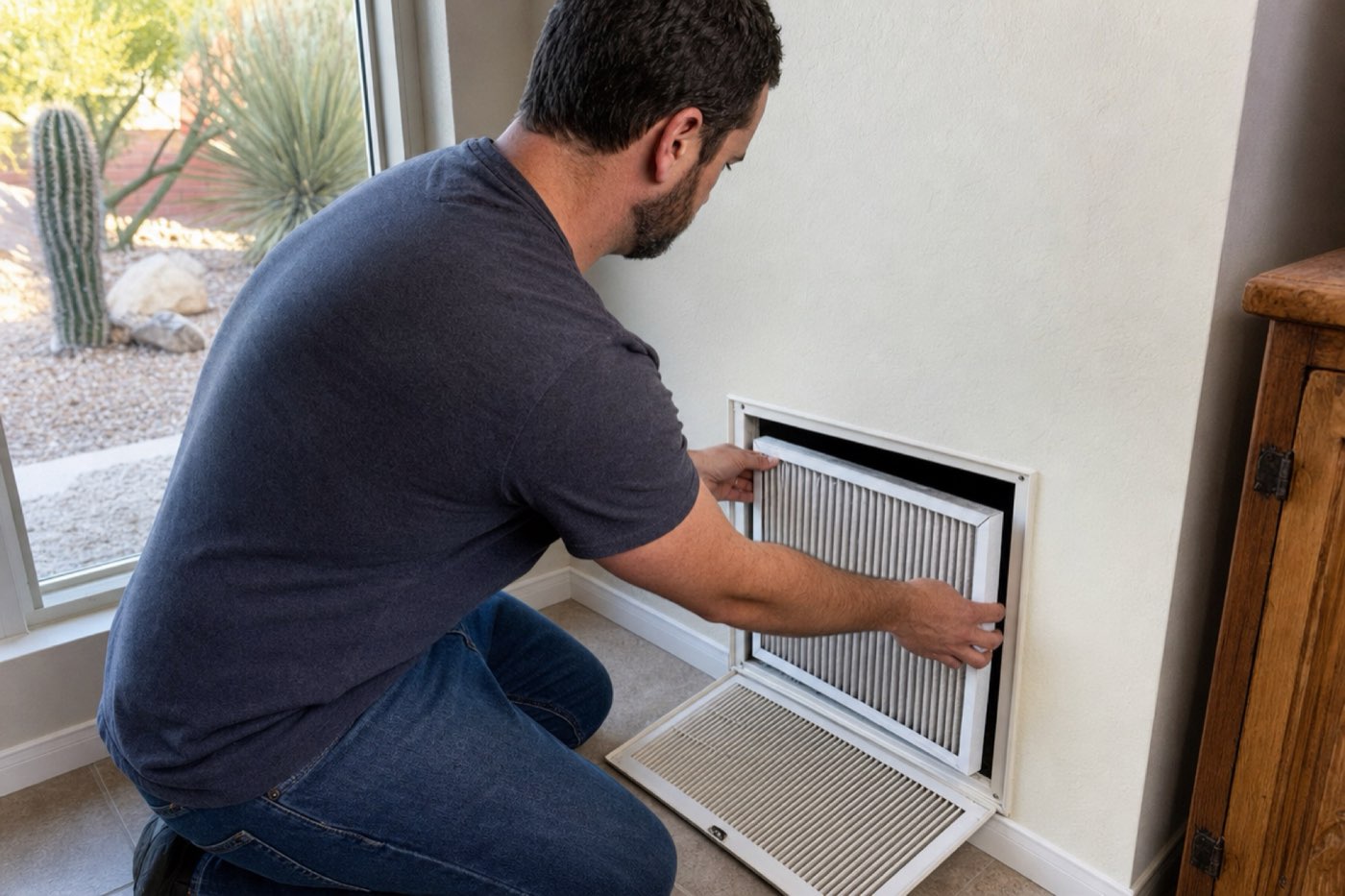
EPA says a filter should fit snugly without air leaking around it and without bending or crushing it. A filter forced into a slot that is too small, or a loose one that lets air bypass, defeats the purpose no matter what its MERV rating is.
What should you do this November?
As snowbirds return and heating season begins, a quick check before the first cold nights saves trouble.
- Pull the filter and note its size and MERV rating printed on the frame.
- If it is a 1-inch MERV 13 and nobody has verified your system, swap in a MERV 8 of the same size.
- Confirm the new filter sits snugly, with no gaps and no bent edges.
- Ask a licensed company about a deeper filter if you want finer filtration.
Frequently asked questions
The answers to common follow-up questions are in the FAQ below.
If you would like help picking the right filter for your system, call (520) 303-1924 or send a service request to be connected with a licensed local heating and air company. Tucson Air Conditioning Repair is a free referral service, not a contractor.